
工程哲學之力學應用
 |
書名:工程哲學之力學應用 作者(中文):景鴻鑫退休教授 任職單位:國立成功大學航空太空工程學系 出版社:五南圖書出版公司 出版年:2025 ISBN:978-626-423-927-1 |
|
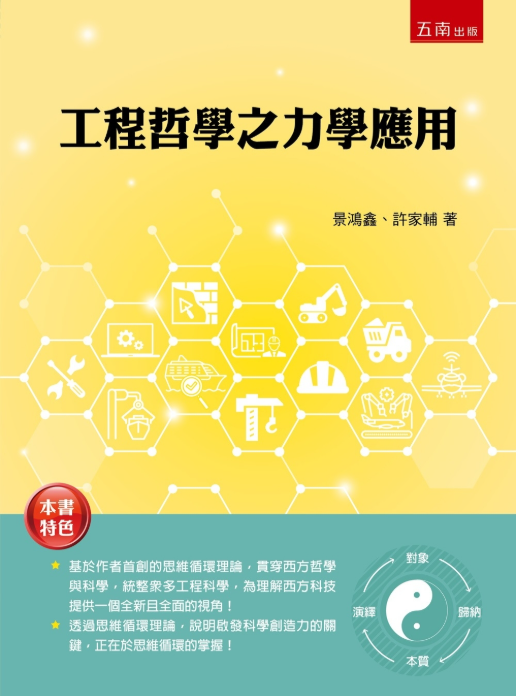
摘要 本書撰寫的核心宗旨,是希望透過希臘哲學的發展,使用基於字母拼音文字,所形成之「對象-歸納-本質-演繹」的線型式思維循環,來說明物理學中三大力學:牛頓力學、量子力學、相對力學的基本思維過程,進而統整牛頓力學所衍生之固體力學、流體力學、熱力學,以及相關的工程科學,來證明西方各類科學工程知識均來自同一個思維循環,以達到透過掌握思維工具,來統御西方科技的目標,大幅降低學習西方科技的障礙,迅速提升學習西方科技的效率,進而全面啟發科學創造力。 本書以牛頓力學及其工程應用為標的,主要探討的對象為在古典物理學中,牛頓力學與熱力學所延伸出來的固體力學、流體力學、熱力學,及其相關應用的土木、機械、造船、航空的各類工程學;如固體力學的材料力學、結構力學、板殼理論,以及流體力學的水文學、明渠水力學、空氣動力學,與熱力學的熱機,更包含了結合不同領域的耦合工程問題,如土壤力學、流體引致振動學、熱彈性力學,詳細說明其理論推導過程中,相關的思維循環建構,及其相關的物理意義與邏輯上的要求,以提供讀者對於該科學理論與工程學背後之思維過程與意義的徹底了解,呈現西方哲學思維的應用示範,展現思維工具的掌握才是科學與工程創造力的來源。 |
|
|
Jing, Hung-Sying Abstract The main goal of this book is to expose the linear thought cycle: “object-induction-essence-deduction”, from Greek philosophy based on the alphabetical writing system, underline all western sciences, such as Newtonian Mechanics, Quantum Mechanics, and Relativistic Mechanics, and the corresponding Newtonian type engineering theories among Solid Mechanics, Fluid Mechanics, and Thermodynamics, to show that the linear thought cycle is actually the basic scientific way of thinking. If one can fully understand and further know how to manipulate this cycle, the obstacle in learning science will be lowered, and it will be easier to realize all western science, and further, the creativity in science and engineering will be enhanced. For simplicity, this book using the linear thought cycle concentrates on mainly Newtonian type engineering theories in the fields like Civil, Mechanical, Aeronautical, and Naval Architectural Engineering, such as Mechanics of Materials, Structural Mechanics, and Theories of Plates and Shells in Solid Mechanics, Hydrology, Open Channel Flow, and Aerodynamics in Fluid Mechanics, Heat Engine in Thermodynamics, also Soil Mechanics, Flow induced Vibration, Thermo-elasticity in coupled engineering. With clear description about the thought cycle in deriving all the engineering theories in detail, also including the corresponding physical meaning and the requirements from logic, so that the readers can thoroughly realize the operation of the thought cycle, and learn to use this thought cycle to enhance the creativity in science and engineering. |
|